Showing posts with label BAR07. Show all posts

Tuesday, 16 August 2016

INTERACTIVE :: 16/08/16 - Unity Exercises

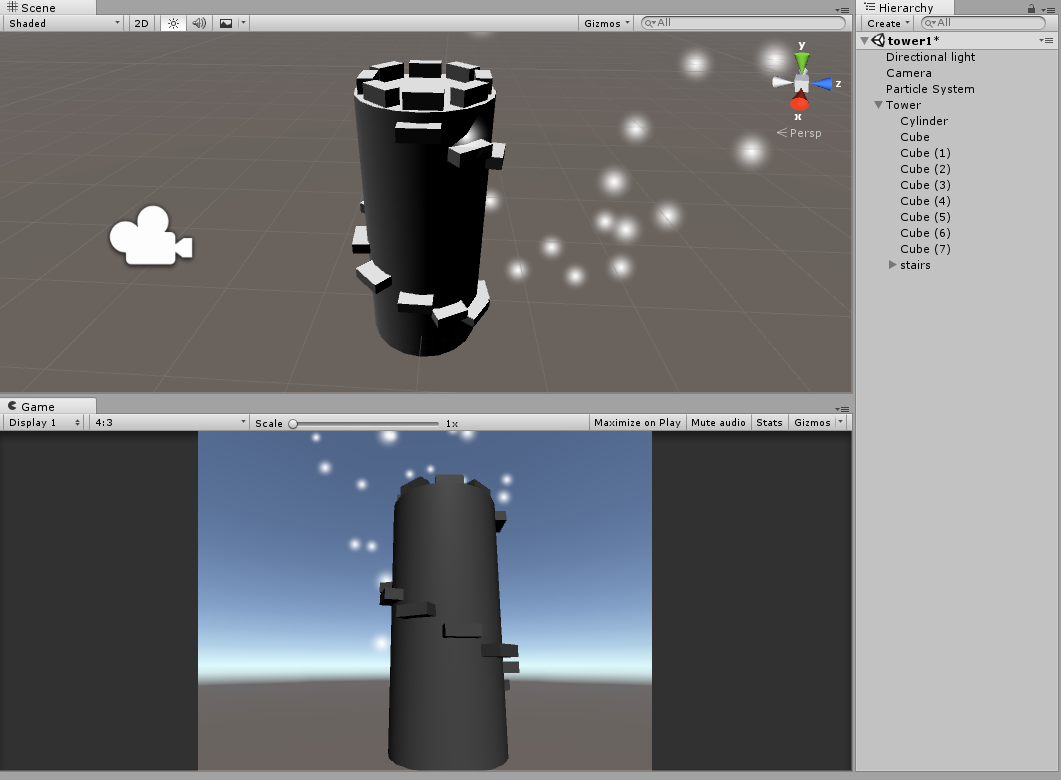
At the end of last week we begun work with Unity and were asked to build a tower out of basic 3D objects.  I didn't upload it here, but now I'm realizing that I should have, just in case I forget to load my exercises onto a flash drive and bring it to school again.

So here it is:


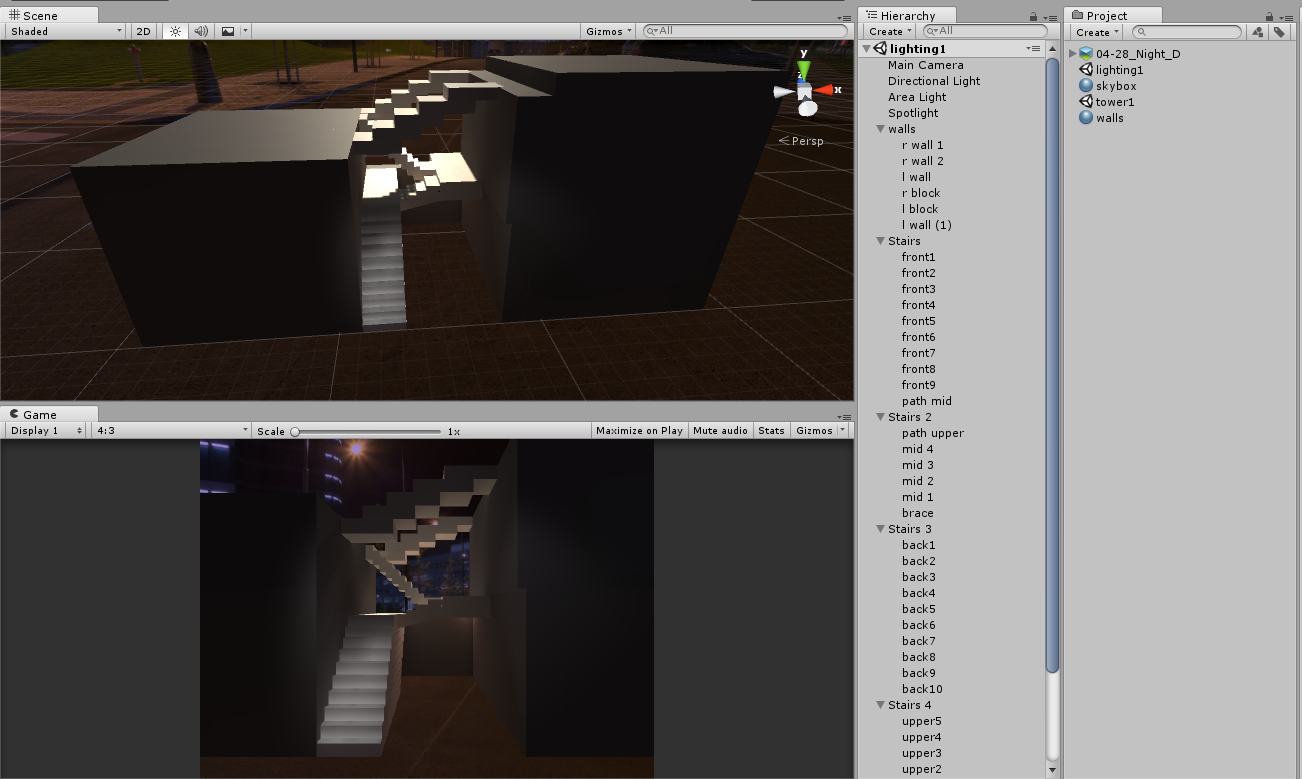
Our assignment for today was to create a scene from a photograph, and then adjust the lighting to match an inspiration photo.  Admittedly, I did not find an inspiration photo, but I used one of the textures from NoEmotion HDRs and tried to tweak my scene to match the lighting that it displayed.

Here are the results in the form of my work space:

I'm hoping that we'll learn how to put textures onto our materials soon so that I can make my scene look a bit less matte.

Monday, 15 August 2016

INTERACTIVE :: 15/08/16 - Concept development

We were given feedback on all of the designs we had created so far and were expected to take that feedback into stride and improve on our concepts based on it.  It seems that mine were pretty good overall, but there were a few changes I was asked to make

WEAPON
- Make a more polished, cleaner version
- Give it some battle stats

STEAMPUNK ITEM
- The handle is very clunky.  Rethink this object

ENVIRONMENT
- An idea would be to make the monster less visible to add to the horror/surprise elements.
- Add additional concepts
- Tweak the monster's mouth, give it more teeth.
- Adjust the values in the shaded concept.

As we didn't have to fix all of our concepts, I chose to work on my environments since they needed the most adjustment and development.  Below I have created three additional concepts:
An extra concept of the sunflower's head, with more teeth added as per suggestion.
A profile view of the building, in order to gain a better sense of space within the environment

And finally, an exterior shot of the building, as well as a color palette test.  I used a lot of grungy textures to keep in theme with the horror elements.


Wednesday, 6 April 2016

INTERACTIVE NARRATIVE :: Gameblogging 06

Of the key narrative elements discussed so far in the course (interactivity, level design/linearity, moral choice/non-linearity, character), which do you think is the most prominent, important or interesting in your chosen game?

This week my chosen game was Terraria, one that I have had previous experiences with and enjoy immensely.

Its narrative is created through the player's curiosity - you are placed in a world with only a guide to give you a basic tutorial - one that you do not even have to pay attention to.  Therefore, due to such an open nature, I believe that the most important element of the game is in its linearity/level design.

"Open-world video games offer the player the choice to engage in an immense range of optional activities that do not necessarily contribute to closure, but rather to expand the player’s experience."  I believe that this quote from Cardoso's Breaking the Game is particularly relevant to Terraria, as it is a game that does not limit the player to a linear sequence of events.  The whole point of the game is for the player to experience it - there is no Ultimate end goal beyond 'do everything that the game has to offer'.  Players are given the options to defeat bosses and explore every last inch of the world, but there is nothing saying that they have to.  The experience is driven by the player's curiosity.

There are limitations in place to make sure the player is constantly challenged; they start out with weak weapons and universal monsters (slimes and zombies) that spawn frequently during the day and night respectively.  The only way to get stronger is to collect various materials from the world's surface and underground in order to craft stronger weapons,armor and structures to better defend yourself.  This in turn creates a reward/goal system for the player from the get-go - through exploration, the player uncovers more of the world, and finds more equipment/materials to become stronger to explore further or enhance their experience.  The player also gains new villagers through a crafting element - making houses for these villagers to move into - and provides reward for the creation /building aspect of the game with the perks and unique items that the villagers offer once they are settled.

As stated in week 3's level design lecture, "Clever level design matched with enemy/obstacle placement will make for a compelling experience and it ought to contribute to the narrative experience as well".  Terraria presents a linear, 2D terrain with different biomes representing the different areas of the world.  Within these biomes are different kinds of enemies with varying strengths, and different types of materials for the player to customize their equipment and appearance, as well as build structures with.  Each world is unique due to its randomized creation, therefore the player will never know in advance the kind of terrain or dungeons that they will explore, where to expect new biomes, or know what kind of equipment and treasure they will find in the randomly generated treasure chests.

The idea of clever level design can also be applied to the player's created structures - Besides the edges of the map and the generated terrain of the world, there are no restrictions on how tall you can make a structure or how far down into the world it can go.  Players can build walls that monsters cannot pass over in order to defend their villages better, or may use trapdoors instead of regular doors to prevent monsters from opening them.  Traps can also be utilized to prevent monsters from entering inhabited areas.  Again, ideas are only limited by the player's creativity and by how far they want to push the game.

Overall, the terrain and design of the world and its denizens helps to shape the player's experience by providing a large and excellent landscape to explore and discover.  While it may be enticing for new players, it also provides a unique experience for veterans, as no two worlds will ever be alike and while each world contains a finite amount of elements, they are always presented in new ways and require different methods to overcome them.

Wednesday, 30 March 2016

INTERACTIVE NARRATIVE :: Gameblogging 05

Could your game have developed its narrative and told the same or a similar story without any of the characters? 

This week I chose to play Fez, a puzzle platformer and believe that its narrative could definitely be developed similarly if the characters were removed from the game.  It offers very little in terms of verbal exposition and worldbuilding, using only a 'guide' character named Dot to explain the game's mechanics as they come up.  The rest of the story is represented visually through use of different environments that the central character travels through, and gives insight to the worlds that must be saved and protected.

I believe that the central character, Gomez, is an avatar.  The definition of the avatar in this regard is "any game-unit that has action possibilities and that answers to the player" (Kromand, 2007).  He is a silent protagonist who the player uses to traverse the different worlds in Fez, gathering fragments of a cube in order to restore the equivalent of a cube-god in this world.  Because of the idea of the avatar, Gomez could be replaced with anything - a shape, a blob of color, and as long as he could still respond to the player's input and commands, the story could play out almost identically to the way I experienced it using the ideas of learning through experience and showing rather than telling.  

Cube fragments glow and flash in a way that suggests you need them.  Completing a whole cube makes Gomez do a little animation to signify that you've done something important.  The narrative is simplistic, giving the player a call to adventure and the means of obtaining the elixir as presented in the hero's journey - collect small cubes to restore the god-cube before the world, along with you, is torn apart.  And because of this, I believe that the story in Fez could be easily presented in a more abstract way, and even without the use of its characters.

Wednesday, 23 March 2016

INTERACTIVE NARRATIVE :: Game blogging 04

How does morality influence the choices you make in the game?

This week's chosen game was The Banner Saga, which has a play style that leaves the player in a leadership position.  Between playing as Ubin, Rook and Hakon, the player needs to make decisions that will affect an entire army of characters and needs to plan their moves strategically in order to keep army morale up and casualties down.

I found myself faced with a number of moral dilemmas when playing this game, though the storyline was rather difficult to get a hold on to begin with.  In the second chapter, Alette was about to be crushed by a Dredge, and from a moral standpoint, I felt I had to step in and attempt to rescue her, even though Rook was very far away from her at the time.  The outcome of the event was not one that I was expecting, and another character died protecting her instead.  While sorrowful, it was a better outcome than I could have hoped for, and though one life was exchanged for another, I felt that preserving Alette's had more bearing to the plot.

Much smaller moral choices have appeared throughout the game as well, such as Hakon's discussions with prince Ludin, who came off as a suspicious and warmongering character to me.  Diplomacy is important when playing a game involving large nunbers and strategy, so my knowledge of this tells me not to ruffle any feathers or displease allies, but at the same time I find Ludin unbearable and feel like he could stand to be insulted a few times.

I've noticed in my playthrough that I have chosen many cautious options as a means of preserving my armies and keeping as many people as safe as possible.  One part with Hakon shows a smoke signal in the distance and I chose to send warriors to it in case it was a trap.  When they did not return I searched for them myself only to find new allies and my varl telling me that I'd missed a good battle, which made me feel pleased with my decision.  In a different chapter, Rook and his village must enter a town that has been closed to all outsiders and the options are to break down the gate and risk your ownl varl getting shot, sneak in with a food supply cart which would deny the other refugees waiting outside the town provisions if you fail, or wait to see if the gates would open by waiting for the long haul.  This was probably the most difficult decision for me, as the first two options had very harsh consequences upon failure and could lead to character deaths, while waiting meant that the dredge would only get closer and make things even worse.

In the end, I left Rook and his party to wait things out, feeling as though the death of characters I had grown attached to or the potential wrath of starving refugees would be worse than the onset of dredge.  At this point, I haven't found out what the consequence of this action has been, so while I play through Hakon's campaign and try to keep my army's casualties to a minimum, I worry about whether or not I have made the right decision.

Wednesday, 16 March 2016

INTERACTIVE NARRATIVE :: Game blogging 03

Are the “choice situations” in the game obvious or subtle? Do you know the outcomes of your choice prior to making a decision?  


This week I have chosen to play The Wolf Among Us, and in true Telltale Games fashion, has the player answering choosing how to respond and answer to the characters and situations around them right off the bat.  

Domsch (2003) talks about the nature of a choice situation and states that "One important aspect of choice is therefore how informed it is – that is, whether we choose based on knowledge or arbitrarily. Choice situations differ in the amount of information that is given about the consequences of the different options." There are plenty of choice situations within the game, and the first conversation with Mr Toad proves this.  The model that the player follows is one of incomplete information - "the agent is provided with some knowledge about possible outcomes, but no certainty in relation to the probability of the outcomes, and/or the completeness of information about outcomes." Bigby and Toad explain enough in the introduction sequence for the player to understand what the Fables are and what a Glamour is before being put into a situation where Toad does not have a glamour on him and being presented with the consequences of such an action.  The world suggests that Fable without glamour can be punished, but depending on how the player feels, they can make Bigby be kinder to Toad and let him off, or give him a warning, both of which affect the player's relationship with the character.

The game cues you in whenever you make a decision that will affect another character, or make a choice that will have some impact later on in the game, informing you with notes in the corner such as 'Colin will remember this' or 'You chose not to lie to Beast'.  The choice situations tend to be mixed in with smaller, minor dialogue choices that Bigby makes, so I often didn't realize that I was making a potentially game-altering decision until after I had made it.  That said, I tried to keep Bigby's choices true to how I would have responded in the same situation, favoring peaceful dialogue options and trying to be as honest and friendly with the characters as possible.  This may play into the idea of gameplay guided choice over moral choice, as keeping peace between my PC and the NPCs of the game means that they will not have any ill will towards me, and hopefully won't find ways to condemn my character further down the line.

Some consequences in game are immediate, leading to some rather expected outcomes - if you're a dick to the Fables, their opinion of you is generally bad as well, but the truly game changing decisions that the player makes are presented at the end of each chapter, shown in pie graph form.  These graphs tell you things like whether or not you chose to give Faith your money, who you think killed Faith at the end of chapter 1, and whether or not you saved Prince Lawrence.  There is no right or wrong in any of these choices - the graphs at the end merely show you how you stacked up against other players, and how the story changes because of your decisions. 

Tuesday, 15 March 2016

INTERACTIVE NARRATIVE :: Week 4 questions

Week 4 Reading Questions

Anatomy of Player Choice - Domsch
1) What differentiates a “choice situation” from the numerous other micro choices a player makes all the time in a game (like whether to jump or crouch, run or walk, move left or right to dodge a projectile, reload after one shoot or three etc…)

The core requirement of a choice situation is that needs to contain at least two different options. It also creates some form of motivation that invests the player in one outcome over another. Choice situations can also play upon the player's emotional preferences, helping them to decide which option to go with.

2) How are “motivation” and “knowledge” important to choice in videogames?

The motivated choice plays upon the player's curiosity at what might happen due to its outcome. This can be combined with the informed or knowledge based choice, where the player knows enough about the video game's mechanics and world to select the 'right' option. The motivated choice is needed to show the player that the outcomes of both choices will not be identical, and it achieves this through the information that the choice provides.

3) What kind of game structure does the “teleological attitude” work best with and why?

The teleological approach would work very well with a linear game structure and unidirectional or progressive paths. When the player is presented with a choice, the options are geared towards the favor of one more than the others, meaning there is generally a 'right' and 'wrong' path. Choosing the 'right' path lets the player proceed through the game and towards further nodes on the string, while choosing the wrong path eventually dooms the player to failure.

4) Do you agree that videogames place an emphasis on speedy action, particularly when it comes to game choices? Can you think of any exceptions to this?

I can definitely agree that most video games place emphasis on quick action, especially when it comes to games like The Wolf Among us and things that involve quicktime events. Even with games like Skyrim and Dragon age, the player generally cannot save the game during a choice and tends to want to progress in order to continue the story, making decisions on the spot as well. The only example I can think of that doesn't is Eyri's Action, but the game purposely makes you take it slow and destroys all previously ingrained knowledge of how video games are supposed to work, forcing you to consider your choices carefully and avoid the illogical traps and pitfalls that it throws at you.

Moral Choice in Games – Perdue

1) Do you think the player’s moral choices should be rewarded in a game?

No, not unless the situation's outcome calls for it. Do you think we should be rewarded for feeling strongly about something or going with your gut feeling? I feel like it should be the same in video games, as it creates a more true to life and realistic experiences, and strengthens the idea of the character within the story.

2) What is the difference between a choice driven by morality and a choice driven by gameplay mechanics?

Choice dictated by gameplay directs the player to choose one option over another in order to gain 'points' or 'skills' associated with that choice. The choice no longer becomes about the player's feelings towards the situation, but hinges on how they are going to benefit by answering a certain way. Moral choices lie more with how the player feels about the situation and what they would choose or not choose if they were put into the situation themselves.

3) What is the most meaningful choice you’ve made in a game?


The most recent that I can recall is the conscious decision to spare every last character I came across in the game Undertale. Just before the final boss, a character appears to judge the player for every act of violence that they committed and every level that they gained. I remember the speech explaining what LOVE and EXP were acronyms for hitting me very hard, and it was a very powerful and dumbfounding moment for a first time player. By choosing not to kill, I gained an extra bit of dialogue, which I found quite touching, before being able to progress with the game.

Wednesday, 9 March 2016

INTERACTIVE NARRATIVE :: Game blogging 02

Do the story nodes in your chosen game work well to support gameplay and gameplay objectives? Why or why not?

Sonic's story nodes are presented in the form of 'zones' that Sonic must move through in order to complete the level.  They show the progression of time in the game and act as markers of the 'distance' sonic has traveled in the world.  For example, sonic starts off in rolling green hills, and after freeing his friends, he moves on to another area which is much more mechanical.  The environment reflects the kind of robots he will encounter (semi-organic insect and fish robots in Green Hill zone compared to more obviously metallic bullet shooting creatures in Chemical Plant zone).  Since the first Zone had Sonic defeating a boss in the second Act, the player can immediately assume that it will be the same in the second Zone, albeit with the antagonist driving a different machine that will ultimately require different tactics - most likely something learned in the first half of the zone (such as utilizing travelling pipes or springs) - to get past.

One could say that it fits the string of pearls model, but only barely - the gameplay is extremely linear 'travel from point A to point B', and the only instances of 'pearls' that I can think of from the segments that I played being the short introduction to the boss of each Zone.  It would seem to focus on a 'show, not tell' dialogue, but this may be largely due to the limited space that old Sega cartridges have compared to the video games of today.

The game thrusts the player straight into gameplay with no explanation, tutorial or end goal in sight, the only instances of variety being the changing levels that Sonic must navigate through.  I feel like the first level and the gameplay helps the player to understand what to expect in future levels, but while the changing backgrounds present fresh scenery and keep the player interested with their different mechanics, the overall lack of any dialogue or story makes it fail in terms of a dynamic and informative game.  Your objective to get to the end of the level in each area is clear, but without the storyline found in the game's manual, the player would never understand that their goal is to collect chaos emeralds to stop Robotnik from taking over the world.

Thursday, 3 March 2016

INTERACTIVE NARRATIVE :: Week 2 Questions

Week 2 - Reading
Salen and Zimmerman Games as Narrative Play

  1. J. Hillis Miller outlines a handful of components that constitute a narrative: “There must be, first of all, an initial situation, a sequence leading to a change or reversal of that situation, and a revelation made possible by the reversal of the situation. Second, there must be some use of personification whereby character is created out of signs – for example, the words on the page in a written narrative, the modulated sounds in the air in an oral narrative. However important plot may be, without personification there can be no storytelling… Third, there must be some patterning or repetition of key elements.”
    Give one example of a game or film that conforms to this definition of narrative.
Dragon Age Inquisition conforms to this definition of narrative, as the sky more or less explodes, creating an enormous rift that disrupts life as it was in Thedas. Personification appears in the form of the player's character, who is fully customizeable and serves as an avatar/vessel for the player and all the decisions that they make in the game. The key elements in the story appear as snags and quests along the way which are related to the breach in some shape or form. The player must recruit followers, close rifts, and fetch things for NPCs in order to get closer and closer to the goal of closing the breach for good.

  1. S&Z refer to types of narrative in videogames, embedded and emergent. Define each of these and give at least one example of each from videogames.
Embedded narrative is a pre-generated story that is interactively told and exists before the player's interaction – the example in the reading suggests Jak and Daxter as two characters who are saving the world. This is crafted interactive story. Emergent Narrative is the experience when the game is played – again referring to Jak and Daxter with their story forming and changing through the player playng the game. This is improvised play experience.
  1. In what ways do games combine embedded and emergent narratives?
Games link the embedded and emergent narratives togeter – the embedded gives the player motivation to move forward in the game and gives meaning to any actions that they take, while the emergent provides the challenges and thrills that make the game feel fulfilling and advance the story.

  1. How do goals, conflicts, and core mechanics make gameplay meaningful?
The Goal helps the player to judge how far they are in the game and understand the significance of their actions within a narrative context. It describes the nature of player interaction with the narrative context and thus makes the interaction meaningful.
Conflict creates an obstacle for the player to overcome, giving opportunity for narrative events and aids in the player's satisfaction of reaching the goal. It is an element that works against the player's success and tries ultimately to lead to the player's failure.
Core mechanics create patterns of repeated behavior and frame the moment to moment activity of the player. It forces the player to pay attention to the game and to understand and learn what their limits within it are and teaches what they can and cannot do to reach the goal. The player engages with the core mechanics to make meaningful choices and explore their possibilities.

  1. In what ways does a “game space” contribute to context, time and causality?
The design of a game space creates events in these concepts of context, time and casualty. Design changes depending on the type of game, but it helps the player to interpret just how they can go about playing the game and offers many possibilities and choices in how they can succeed. The game space contains the embedded narrative qualities to help shape the story and help the player understand and achieve the goal.

  1. How do “game descriptors” contribute to a game’s narrative? What are some examples of game descriptors? Are they always effective?

The game descriptors help to identify objects in the game, giving meaning to what might otherwise be (particularly in early games?) abstract shapes on the screen. The narrative descriptor frames the elements inside and outside of the game as objects that communicate the story. These descriptors could be all the objects you see on screen – the player character, identified by the one moving when you touch the controller buttons, scenery, identified by the familiar shapes of walls and rocks etc, enemies, identified by shapes that may be differntly colored to your character sprite, and create a reaction in the form of blood/flashing colors/sounds when they touch you. They may start out as ineffective, but to one conditioned to video games, signs of what approaching figures or shapes are can be more easily identified based on previous games and previously understood 'rules' from them. The game descriptor helps to contextualize objects within the game so that even new players can begin to understand what shapes do which things, and which objects to attack or avoid.


///


Week 2 – Video Questions

  1. Do you agree with me that The Walking Dead by Telltale Games doesn’t really offer the player meaningful choice? Does it really matter if it does or doesn’t?
I can't take a stand on agreeing or disagreeing about meaningful choice as I'd have to experience the game for myself, but as someone who doesn't set replaying games very high on their list of priorities I feel like it doesn't truly matter whether the game's choices are meaningful. In my opinion, once you know what's going to happen in the story, the experience of replaying it is ruined – you already know what's going to happen and while you might be curious to see what kinds of other choices you can make in the same scenarios, the overall experience of the game will feel diminished as the main plot points of the story driven narrative will not change and thus you can already expect to know what twists and turns the story is going to take.
  1. How does The Walking Dead incorporate minimal interactivity to make the player feel like they are driving the story forward?
The dialogue options that your character is given are often under a time limit, making the player feel like they must make a snap decision in order to avoid consequences. The same is true for the game's quick time events when faced with a character's reflex actions or during fight scenes – if the buttons on screen aren't pressed quickly or for long enough, consequences also occur. The game plays on the player's desire to avoid death or harm coming to the character they have played thus far with and continue the progression of the story.

  1. How could The Walking Dead have incorporated more player freedom, and how might this have impacted the telling of the story?
As the video mentioned, the player is only in control of certain 'scenes' that occur between cutscenes and dialogue/quicktime events. They do not have the freedom to explore an open world or to make choices beyond the the ones presented in the dialogue options. The video mentions that Clem leaves her gun out in the open and the player is not allowed to retrieve it for the sake of the story, even though the player knows that it is a terrible decision to put the gun down for even a moment. With more freedom, it would be much harder to keep the narrative on track, as the player would be exploring and getting into encounters that they weren't supposed to. The consequence could be similar to those in Bethesda games – where the player is free to do whatever they like at the expense of never progressing or completing the main story, or being left to do whatever they liked once the central 'backbone' plot is complete.

  1. What is the tension between “me the player” and the intended actions of “characters” in a game like The Walking Dead?
Sometimes – particularly when the player has experienced the sequence of the game already – the player will want to take actions that the characters within the game would not think of/cannot do due to programming. The player might find the character's current goal or motives unnecessary or would want to do things differently, or the character's actions might create a sort of frustrating tenseness in the player, due to knowing the trope that the character's actions will ultimately cause.

  1. The game Until Dawn is an interactive horror film where choices determine who survives. How does the player’s prior knowledge of horror tropes influence their choices?
Many people who have played this game say that it relies heavily on Horror tropes, and that if you know how those work, its very easy to avoid danger/disaster and make it through the game with most of, if not all of the characters surviving. There are 'rules' to a horror film, and characters can all fit into horror stereotypes, many of which suggest that they will die before the end of the game. However, Until Dawn also gives you the option to circumvent what is otherwise predestined within a horror film, as every single playable character can survive.

  1. Do you think that choice makes an interactive narrative more dramatic? Are the limited choices in games like Until Dawn and The Walking Dead enough to make these choices meaningful?
The idea of choice, even if it does turn out to be a superficial one can definitely have meaningful impact on the player, as it helps to engage them more with the story and make them feel that the choices that they made had a certain weight or impact on how things turned out. I feel like an interactive game could definitely be considered more dramatic – on one hand the player could make force drama by purposely insighting fights and discord among the characters or making the characters enter situations that anyone with common sense would avoid. On the other, they may choose to avoid dramatic situations by 'playing it safe' – but no doubt the video game accomodates for that and can potentially throw in even more surprising twists and turns at the player in order to constantly keep them on their toes.

  1. In what ways might an interactive narrative lack the qualities of “traditional narratives,” such as twists, tropes, symbolism etc… What do interactive narratives offer instead?
The interactive aspect of a narrative means that the set in stone, solid backbone of a traditional narrative is missing due to the free will and choices that the player exerts over it. The story can turn to unexpected places the symbolism and hints are reduced in order to create a deeper sense of mystery and involvement. As the Gamer Maker's toolkit has suggested, however, the interactive narrative can offer the player to direct and form a plot based on their own whims and ideas. It allows the player's imagination to run wild, to create a game out of the game itself by pulling the strings and avoiding or travelling into the common tropes that one expects. It also offers a more immersive experience, as the player feels as though their choices have a direct impact on the story at hand.
Tuesday, 1 March 2016

INTERACTIVE NARRATIVE :: Gameblogging 01

Does your chosen game make user input feel meaningful in terms of story direction and progression? Why or why not?

The conflict and central story of Facade is staged very clearly – The PC's friends,Trip and Grace are in an unhappy marriage as they fight before the PC arrives, they make passive aggressive remarks to one another while they're trying to be hospitable, and eventually break out into a full scale confrontation that the PC must mediate in an attempt to meet a peaceful outcome... or so I would assume.

My playthrough ended with Grace leaving before Trip could confess that he was having an affair, and though I answered as personably and as honestly as the real me would have in the situation, I didn't feel like my input had any strong or lasting effect on either character and that this ending was inevitable. They seemed so argumentative over seemingly insignificant things and gave off the impression that they hated each other so much that it honestly left me feeling helpless to even try to solve anything between the two of them. Half the time what I typed went completely ignored or Trip and Grace just side-eyed each other awkwardly like they weren't sure what I meant. Other times I would try to help one or the other, only to accidentally interrupt them or answer a question that I hadn't heard and didn't mean to answer. Grace asked for a lot of yes/no answers, and simply interpreted my words as yes or no depending on if I had a negative or positvely associated word in it – I kept typing 'you shouldn't be fighting' and the AI interpreted it as me telling her she shouldn't feel like she was important or she shouldn't want to be an artist. It felt like my answers only mattered when I insinuated 'yes' or 'no' and everything else I said was inconsequential.

From what I gathered of the story, Grace was mad that Trip wanted to go on vacation all the time? Trip was mad that Grace was always angry and frigid? It felt like the pettiest conflict but over the course of my playthrough, I couldn't figure out whether there was any deeper meaning to it, though I felt like there had to be. I feel like this game is a case of too much player freedom and not enough actual player interaction. Realistic as standing around in a modern setting and talking is, its neither immersive nor stimulating to feel like the player's words don't mean anything and that the AI is only acting on key phrases.

Thursday, 25 February 2016

INTERACTIVE NARRATIVE :: Week 1 Questions

Wk1 Video Questions

TFX – Gaming Moment
  1. What is the significance of the player coming up with a “gaming moment” or gaming narrative when playing a videogame?
The gaming moment helps to solidify the personal experience of the player, and adds to their understanding of the game itself. By discovering what they can and cannot do in the game, or experiencing something that is different to the proposed gameplay, the player learns where their boundaries lie and what they are able to do within them. It teaches the player how to play without holding their hand and giving direct instructions, allowing them to learn through their own mistakes and in-game choices and decisions.

  1. Is my story of ejecting upside down a game narrative? If so, why? If not, why not?
Yes! Through ejecting upside down, you as the player are discovering limits and boundaries to the game and heightening your gaming experience. It also plays on the idea of a consequence of action narrative, in that the player character suffers quite graphically, especially for a game of this time period. The player experience also creates a story that can be spread to other players of the game, who may then go on to experience the event for themeselves in order to discern whether the original storyteller was being truthful and to create their own reaction to the situation.

  1. What is one of your favourite game moments? Was it deliberate in the game, or did you come up with it through experimentation?
For me, one of the earliest gaming moments that has stuck with me was playing the old 16 bit game King's Quest I when I was very young. I'd watched my dad play the King's quest series many times, and through that understood that there were many different ways that the player could die. Playing the game was an anxiety inducing experience for me and my sister, as we were afraid of making mistakes or accidentally clicking in the wrong place to induce one of many pun-related deaths. At one point in the game, the protagonist, Graham, can enter a gingerbread cottage in order to obtain some items necessary to progress the story and potentially kill a witch. However, the witch captured us in her house and locked us in a tiny cell, which terrified us, and after a minute or so had passed, the scene cut to outside her cottage, where she emerged from the door holding a terrifying low graphic gingerbread version of Graham and placed it on her lawn alongside three gingerbread children. The terrifying part for me was the bulging marshmallow eyes on the Graham cracker and the screaming pixel mouth that he had – I had nightmares for weeks and because of that, I was determined to never get caught by the witch again. It was not a deliberate decision for us to remain in the witch's house when she returned home, we had no idea that she would interrupt our snooping. Weeks later one of my friends came over to visit and after my sister told her about the graham cracker incident, she proceeded to change my desktop wallpaper to a tiled version of graham's screaming cracker face.


Gamemakers Toolkit – Ico
  1. What does Ico teach us about the relationship between narrative and design in videogames?
Ico's approach to design aims to show a very clear link between the elements within the game and the core concept that the game developer wanted to express. Everything within the game focuses or reflects the core concept of the relationship and values of Ico and Yorda, and everything that did not relate to this concept in some significant way was removed in order to keep the narrative strong and remind the player constantly of what they and the characters were aiming to achieve, creating a very strong sense of immersion through the prevaling power of the game's ideals and goals.

  1. What are the benefits of “minimalist” design? Can you think of other games that are minimalist?
    Minimalistic design places focus on the key concept and morals of the story, strengthening it by providing no distraction or deviation from the central ideas or goals. The minimalistic approach can create a greater sense of aesthetic and is a concept that is seldom used in most video games today, generating interest for not adhering to the standard and offering a different way to experience a story.

    Fez is referenced as a similar minimalistic game in the video that places emphasis on rotating the world and taking a new perspective.

    A similar game known as Loved could be considered minimalist, as it is a 2D platformer with one core dynamic – there is a voice telling your character who it is and what they should do. As long as you obey, the world sharpens and desaturates creating an empty but logical world. The more you disobey, the brighter and more muddled the game gets, blocks of color covering walls and obstacles to the point that color is all you see. The game parallels the emotions found in one experiencing an abusive relationship.

Thomas was Alone is another game that has been recommended to me, which is a platformer done in a very minimalistic pixel style where the characters are bits of program shaped like rectangles. They have no physical human features though their given names and personalities creates a personable link to the player. The player moves these rectangles through portal doorways at the ends of a 2D platforming stage, and as the rectangles progress, storyline is achieved.